Retirement Reflections: Continuing the Mission
Getting your Trinity Audio player ready...I was thinking about how often we say, "I hope you enjoy the next chapter of your life."
I was thinking about how often we say, "I hope you enjoy the next chapter of your life."
Then I began thinking about that next chapter. Since I like to write, I imagined myself flipping the page to see the title of the next chapter, only to discover a blank page waiting for me: A chapter I'll have to write myself.
Maybe the first line will read:
"Day One of retirement. Slept late. Missed my morning meds. Considered whether this was freedom or poor planning. The jury is still out."
Retirement may be a new chapter, but apparently wisdom still requires an alarm clock.
The vault door in Archives, if you haven’t seen it, has a mechanical combination lock. A long while back I wrote what I thought was the combination of life beginning at the age of seven — years filled with fun memories — until you turn the dial to fourteen. Awkward. Feeling out of place. Then twenty-one arrives and life is grand. It seemed every seven years life alternated between good and not-so-good.
I made it all the way to fifty-seven and didn't know how the next seven years would turn out. Now, at retirement age, it seems I'm in the "good" zone. Hopefully by the time I hit seventy, that seven-year stretch remains firmly in the "good" zone until my last breath.
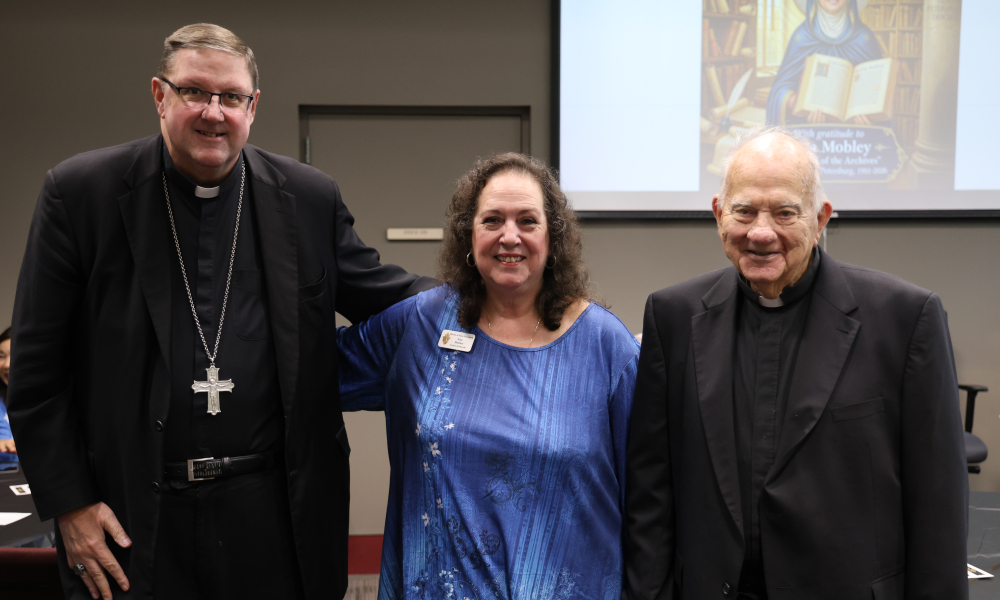
Looking back on thirty-five years with the Diocese of Saint Petersburg, I realize what a blessing this journey has been.
I've worked with so many wonderful people, some who have gone home to the Lord and whom I'll remember forever. Others are still here and will be greatly missed.
I began my diocesan career as a receptionist in February of 1991. Later that same year, in November, I moved into the position of Archivist after Mary Wartenbe retired. The HR Director suggested I apply. After all, it was "just a lot of filing."
I took the bait. And oh boy, did I discover it wasn't just a lot of filing. I quickly learned that “Archivist” was diocesan code for: “We’re not exactly sure who should do this, so let’s ask Lisa.” And somehow, I said yes.
Tucked into that position were responsibilities as secretary for the Director of Stewardship, Administrative Assistant to the Executive Director of Finance handling Estates and Trusts, records management duties, historical research, and assisting other offices when needed.
Through the years, I've been an archivist, records manager, researcher, investigator, asset recovery specialist, volunteer, historian, detective, and occasional therapist.
One of my most memorable moments came during my very first days in the archives. I walked into the vault and saw a Bible dating back to the 1800s. At that point I had been away from the Church for some time and didn't know nearly as much about my Catholic faith as I do today.
I randomly opened that Bible — an 1862 Holy Bible translated from the Latin Vulgate — and my eyes fell upon Wisdom Chapter VII, vs. 16-22:
“To think, therefore, upon her, is perfect understanding: and he that watcheth for her, shall quickly be secure. For she goeth about seeking such as are worthy of her, and she sheweth herself to them cheerfully in the ways and meeteth them with all providence. For the beginning of her is the most true desire of discipline. And the care of discipline is love: and love is the keeping of her laws: and the keeping of her laws is the firm foundation of incorruption: And incorruption bringeth near to God. Whatever is hidden or plain I learned, for Wisdom, the artisan of all, taught me.”
I remember reading those words and feeling that somehow, they were meant for me. I especially loved that Wisdom was referred to as "she." I had a sense then that I was going to become wiser through everything I would encounter in the archives. Looking back now, that intuition proved true.
For Wisdom, the artisan of all, has most assuredly taught me. As I prepare to retire, my heart feels full in a way that is difficult to put into words. When I look back, I see not merely decades of work, but decades of grace. God quietly shaped me through the stories, people, and memories entrusted to my care.
Scripture tells us: "Teach us to number our days, that we may gain a heart of wisdom." (Psalm 90:12)
I feel that truth deeply now. Wisdom came slowly and gently through the lives preserved in our archives. People often imagine an archive as nothing more than a room full of old papers. But after all these years, I know better.
An archive is a heartbeat. Now I realize some people hear the word “Archives” and immediately picture dusty boxes, old papers, and someone telling them to wear white gloves. Honestly, that’s not entirely inaccurate. It is the living memory of a community.
Within those shelves reside the voices of those who built our parishes, educated our children, prayed in our pews, and dreamed of a future they would never see. Their stories have reminded me again and again that faith is not simply inherited. It is carried, nurtured, and passed on like a flame from one candle to the next.
Every document. Every photograph. Every handwritten note. Each one is a thread in the tapestry of who we are.
Together they reveal our joys, struggles, hopes, and the countless quiet ways God has been at work among us.
There were moments when I held a letter or a faded photograph in the vault and felt as though I was standing on holy ground. Correspondence from people such as St. John Paul II, St. Mother Teresa of Calcutta, and St. Katharine Drexel reminded me that history is not distant.
History is alive. History is personal. History is sacred. Over time I learned that preserving history is not simply a task; it is a responsibility.
Parish and school archives play a vital role in preserving the historic record of the local Church. These records help tell the story of milestone anniversaries. They document the development of buildings and ministries. They safeguard sacramental records that are important not only to the life of faith but often to legal matters and family histories as well.
An archive, therefore, is not merely about the past. It serves the present and prepares for the future. One lesson stayed with me throughout my career.
I was once asked to locate records from a long-closed school in South St. Petersburg. The search ended abruptly. The records were never found. That loss still stings.
It taught me how fragile memory can be and how easily part of a community's story can disappear when its value is not recognized in time.
Every archivist has a story that keeps them awake at night. Mine isn’t about ghosts. It’s about missing records.
When I think about preserving history, I often think of families. Families save photographs of grandparents, handwritten recipes, newspaper clippings, letters, scrapbooks, and treasured keepsakes. These items are unique. No one else in the world has the same collection.
Parishes and schools are no different. The records they create are one of a kind. No museum, library, or archive anywhere else in the world has their records. Only they can preserve them.
The same is true for every entity within the Diocese. Every parish, school, ministry, office, agency, and organization creates records that help tell the story of who we are as the People of God. No entity is too small, and no history is insignificant. What may seem routine today may become an invaluable resource for future generations seeking to understand how faith was lived, how decisions were made, and how God continued to work through His Church. If we do not intentionally preserve those records, that part of our collective story may be lost forever. Every diocesan entity has a role to play in safeguarding that memory and ensuring that its permanent records find their way into the archives.
That is why I ask all of you to advocate for archives. Not only for our Diocesan archives, but for our parish and school archives and every Diocesan entity.
Help them understand the importance of maintaining their permanent records. Help them recognize that what seems ordinary today may one day become a priceless witness to faith, community, and God's presence among us.
Some of you know my mother was an antique dealer. I spent years helping her pack and unpack Chiquita banana boxes at antique shows all along the East Coast. After all those years packing and unpacking boxes, I somehow became an archivist and spent thirty-five years packing and unpacking boxes of history.
May the work that continues in the diocesan archives, in every parish, and in every school keep our shared memory alive—not simply as a record of the past, but as a living testament of faith, hope, and God's enduring presence.
After all these years, I leave with deep peace and gratitude, knowing that God has been present in every box, every folder, and every fragile page.