Local Priest, Father Tim Sherwood Releases Fourth Book
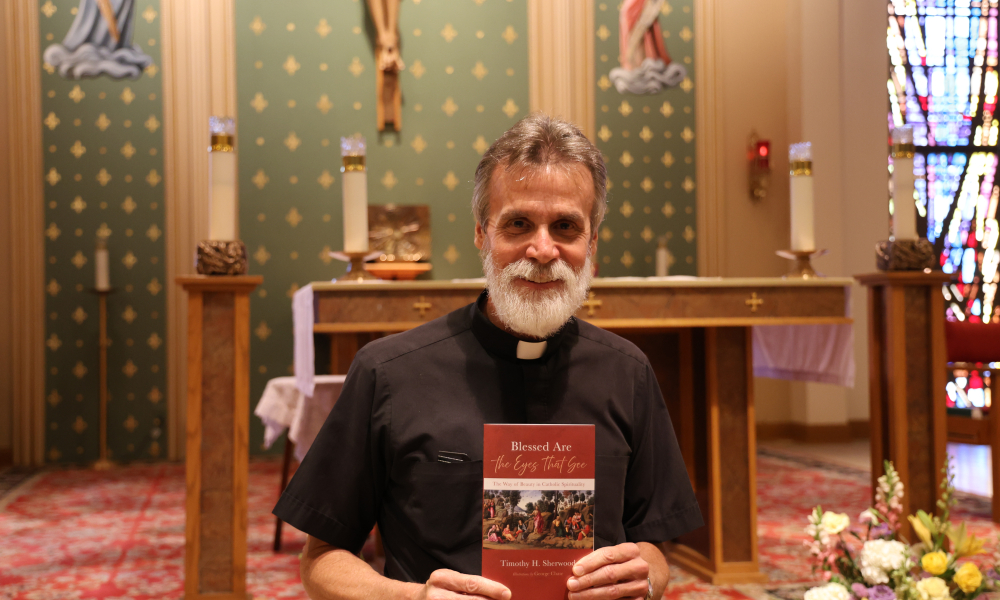
Getting your Trinity Audio player ready...Father Tim Sherwood, pastor of St. Luke the Evangelist Parish in Palm Harbor, recently published his fourth book, Blessed Are the Eyes That See: The Way of Beauty in Catholic Spirituality.
Father Tim Sherwood, pastor of St. Luke the Evangelist Parish in Palm Harbor, recently published his fourth book, Blessed Are the Eyes That See: The Way of Beauty in Catholic Spirituality.
Unlike his first two books, which were more academic in nature, his latest work uses his personal stories and experiences to explore Catholic spirituality and allow readers to see the world through the eyes of faith.
With a master’s degree in storytelling and a lifelong interest in theology, preaching, and the spiritual traditions of the Church, Father Tim shares his experiences as a priest, scholar and storyteller. The book features 30 reflections drawn from real-life experiences and explores topics like discernment, humility, prayer and the presence of God in everyday life.
What inspired you to write this book?
My first two books were academic. My first book was essentially a modified version of my dissertation, and my second book continued in that same academic direction. They were very much written for an academic audience.
With this fourth book, I wanted to reach a more general audience. As a priest, I’m full of stories, and I wanted to expand on those while also focusing on the teachings and spirituality of the Church.
I also wanted to get a little more theology involved, particularly from a cataphatic theological and spiritual perspective. When you look at the things around you, you can see the vestiges or fingerprints of God if you have the eyes of faith. That’s really the overall focus of the book.
I also wanted to give people more insight into the life of a priest. I think there is value in sharing some of the experiences of priestly life that can help people better understand the vocation.
How long did it take you to write the book?
This book really developed over a period of 12 to 15 years. I would write for a while, then stop, and eventually I had this collection of writings that I was able to put together.
I gave them more context and framework, but the stories themselves came from different periods of my life. If I didn't have my other responsibilities as a pastor and with the diocese, perhaps I could have written it in a couple of years. But that's not really the reality for most diocesan priests.
There is so much work to be done in a parish that priests don't necessarily have the luxury of spending large amounts of time writing. In some other Christian traditions, writing can be more directly incorporated into a minister's responsibilities. For diocesan priests, once you're ordained, there are so many needs in the parish that you have to get out into the field.
How have you been able to continue your academic work while also serving as a priest?
I wanted to continue my education because I wanted to become a better priest, particularly in preaching, but I also wanted to use the skills I had been given to write. One of the wonderful things about my Ph.D. program was that it taught us how to write for publication. Research and continued writing for publication were two of the major emphases of the program.
I've always had a creative side, and I've loved being creative, especially when I can tie that creativity to the Church. I've found that outlet in both my preaching and my writing.
What do you hope readers take away from Blessed Are the Eyes That See?
I wanted to focus more on the spirituality of the Church. Unfortunately, there are many people who don't know a lot about our tradition. The Catholic tradition is incredibly rich in spiritual traditions, both Eastern and Western, and I love both.
I want to bring more awareness to that tradition in a way that is entertaining as well as spiritually fruitful. I hope people enjoy the stories, but I also hope the stories lead them somewhere deeper.
I'll always consider myself a student. I'm always trying to read something every day, whether it's spiritual or theological, but especially things from the past and classics that may not have as much light shining on them today.
How do you decide which stories make it into the book?
That has a lot to do with the overall goal and framework of the book. There is an old saying in the Church that what we pray is a reflection of what we believe. I wanted to create a kind of staircase or direction for the book.
I begin with prayer. What we pray is an expression of what's going on within us. Then you ask, what is it that we believe? From belief, it becomes more than just an interior thing. We have to live it. So how do you express that? You go from prayer to belief to action.
The cataphatic approach — seeing the things around us with the spiritual eye — became the context for the book. I have many other stories that I haven't told yet, and they could probably fit into other frameworks.
But right now, I'm not going to rush into another book. You have to put out, but you also have to put back in. My spiritual director has reminded me of the Latin phrase nemo dat quod non habet, which essentially means that you cannot give what you do not have.
I do a lot of putting in so that, when the time is right, I can put out.
Does writing help you in your own spiritual life and priesthood?
Definitely. Writing and journaling can be an important part of spiritual formation and spiritual growth. I'm not a big journal writer, but I see this as an extension of that because writing gives context and meaning to the things that I do. I'm not just experiencing something and then forgetting about it.
I have pages and pages of notes with one-liners reminding me of stories and incidents that have taken place. When you write about those experiences, you have to reflect on them. You have to pray over them and ask, "What did this mean?" You may do that initially, but when you write about it, you reflect on it more deeply.
So it's very important to me. It's good for my own spiritual development, and hopefully it will be good for those who read it.
Do you see a connection between writing and preaching?
Absolutely. André Segovia, the great classical guitarist, once said that when he went without practicing for one day, he noticed it. If he went two days without practicing, his students noticed. If he went three days, everybody noticed.
The same thing happens in the spiritual life. If I'm not reading and if I'm not praying, people start noticing. And then you're not even motivated to preach.
As difficult as it can be, you preach first and foremost with your actions, and let your words follow. That's a lifetime process.
What is next for you as a writer?
I always have ideas. I hope this isn't my last book, and I hope I can continue writing. If not now, certainly when I retire.
The only way a priest retires is from administration. You never retire from the priesthood. I hope to continue ministry, but retirement would give me more time to write. Maybe I'll get started on something before then.
For now, though, I need to put more in. You can't give what you don't have. I want to continue reading, praying, studying and allowing myself to be enriched spiritually so that, when the time is right, I have something meaningful to give.
Blessed Are the Eyes That See: The Way of Beauty in Catholic Spirituality is available for purchase on Amazon.