Mary as a Model of Motherhood
Getting your Trinity Audio player ready...As we look ahead to Mother’s Day on May 10, 2026, we are invited to reflect on this celebration, not only in a cultural sense, but also through the richness of our Catholic faith.
As we look ahead to Mother’s Day on May 10, 2026, we are invited to reflect on this celebration, not only in a cultural sense, but also through the richness of our Catholic faith.
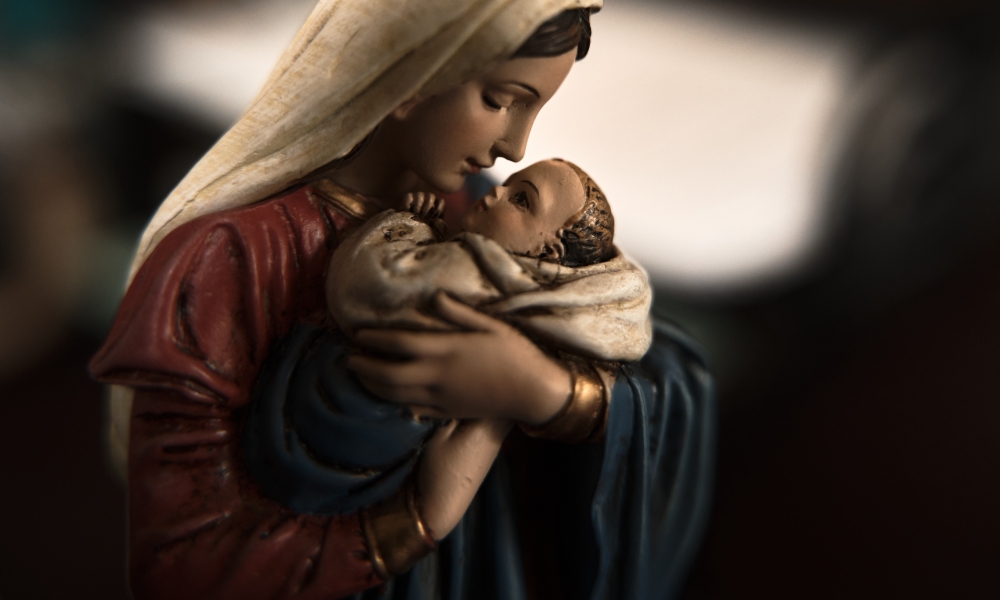
May is also recognized as the Month of Mary. This is no coincidence as Mary is Mother of all and the model of motherhood.
Roots of Motherhood
The world tends to measure motherhood by what it produces as if it is simply a biological function instead of a calling. As Catholics, we are able to recognize that motherhood is a calling from God that involves genuine participation. When a mother cooperates in bringing a child into the world, she says yes to God’s act of creation.
When God chose Mary to be the mother of Jesus, He did not arbitrarily choose a woman from among the people. He chose her because the mission of bearing, raising, and walking with Christ demanded the fullest capacity of what motherhood was always meant to be. She was capable of perfect motherhood through the grace of God.
Perfect Example
No one else in the history of the world has ever been asked to do what Mary did, and no mother has ever said yes so completely. We get a glimpse into this perfection in Scripture, and she serves as a model, not only for mothers but as a mother to each of us as well.
Mary’s first act as mother was to accept the will of the Father. When Gabriel appeared to her, God did not force anything upon her but gave her the opportunity to respond in freedom. As Mary gave her fiat, “Behold, I am the handmaid of the Lord. May it be done to me according to your word” (Luke 1:38), she submitted to God’s will not in passive surrender, but in active and courageous cooperation. Every mother who has said yes to life echoes this yes.
Her yes and her motherhood did not end with the Incarnation. As the Blessed Mother stood at the foot of the cross, she did not flee or turn away from God. She had been suffering alongside Jesus and remained there in emotional and spiritual pain, not willing to see her Son go through His suffering alone. She so clearly knew what every mother knows well: that loving a child means willingly entering into their pain. Her presence at Calvary was a simple yet profound act expressing the love of a mother.
The Gospels repeatedly tell us that she “pondered these things in her heart,” showing us a model of contemplation and attentiveness. She had a deep interior life and, when met with things she did not understand, did not demand explanations, but reflected on them and trusted that God had a plan. In a world of noise and intense reactions, Mary’s contemplative nature and attentiveness to the Lord is a model not just for mothers, but for all of us.
The Catechism of the Catholic Church expresses this saying, “By her complete adherence to the Father's will, to his Son's redemptive work, and to every prompting of the Holy Spirit, the Virgin Mary is the Church's model of faith and charity” (CCC #967).
The Church does not present Mary as an impossible standard, but as a model of complete trust and surrender to God’s will. This is something every mother is called to, even if it is imperfect. It is also something we all strive for whether or not we are mothers.
As St. Louis de Montfort said, “We must look upon Mary as an accomplished model of every virtue and perfection that the Holy Spirit has fashioned in any simple creature. We will then be able to imitate her in the way suitable to each of us.”
Our Mother as Well
Mary’s maternity does not end with Jesus. Immediately prior to Jesus’ death on the cross, we see the moment in which He entrusts His Mother to us, and each of us to her.
In John’s Gospel, he recounts, “[Jesus] said to his mother, ‘Woman, behold your son.’ Then he said to the disciple, ‘Behold, your mother’” (John 19:26-27). In this moment, Jesus establishes that Mary is not just his own mother. John stands as a representative of all the faithful and Jesus’ words are a formal entrusting of His Mother to the Church and the Church to His Mother. Her spiritual maternity is not simply a metaphor, but a reality rooted in her theological role. This became explicit when the Church declared Mary as “mother of the members of Christ” in the document Lumen Gentium.
St. Louis de Montfort put it well when he said, “If you put all the love of all the mothers into one heart, it still would not equal the love of the heart of Mary for her children.”
Having Mary as our mother is deeply special. We have a powerful intercessor who loves us with a mother’s love: a love that is personal, tireless, and perfect. A mother’s love is not abstract, but is specific to each child, each struggle, and each moment. Mary does the same for us. She is not a distant person in heaven but is truly an intercessor who brings our petitions to her Son with maternal love and who never gets tired of doing so. She holds the titles of Advocate, Helper, and Benefactress in addition to Mother because of her deep desire to intercede on our behalf.
The Catechism of the Catholic Church states, “When we pray to her, we are adhering with her to the plan of the Father, who sends his Son to save all men. Like the beloved disciple we welcome Jesus' mother into our homes, for she has become the mother of all the living. We can pray with and to her. The prayer of the Church is sustained by the prayer of Mary and united with it in hope” (CCC #2679).
Honoring Mothers
Honoring earthly mothers takes on a deeper meaning when seen through the lens of Mary. Every mother, however imperfectly, reflects the image of the Blessed Mother: her self-gift, her fidelity, her presence in suffering, and her endless love for her Son which extends to all her children.
Mother’s Day is an opportunity to recognize and thank our mothers not only for the things they have done in our lives but for who they mirror. Their motherhood is truly a participation in Mary’s motherhood.
It is also important to recognize that many have mothers who have died or have broken relationships with their mothers. This is a difficult reality, but Mary does not leave anyone alone in this place. Mary stands in the gap as a mother who is always present and can bring the comfort, care, and love that we seek. Mother’s Day can also carry a quiet and painful ache for those who long to be mothers but have not yet received that gift, and for those mothers whose children live with the Lord following miscarriage or loss. The Church does not ask that these women simply endure the day but rather points them to Mary who knows both the maternal love and deep sorrow firsthand. No longing goes unnoticed, and no maternal love is without meaning in her eyes or in the eyes of the Lord.
This Mother’s Day invites all to grow closer to Mary. Perhaps you can pray a Rosary, pray the Marian Consecration prayer, or simply pray a prayer such as the Memorare with or for your mother.
For information about how to pray the Rosary, click here.
For a version of the Marian Consecration prayer, click here.
For the Memorare, click here.
For an opportunity to grow closer to Mary, consider signing up for the Marian Congress. For more information, click here.