Divine Mercy Sunday: A Gift of Hope and Healing
Getting your Trinity Audio player ready...This Sunday, April 12, the Church celebrates Divine Mercy Sunday, a reminder of God’s infinite love and mercy for us, and the graces available to us through the sacraments of Reconciliation and Holy Communion.
This Sunday, April 12, the Church celebrates Divine Mercy Sunday, a reminder of God’s infinite love and mercy for us, and the graces available to us through the sacraments of Reconciliation and Holy Communion.
Established on the Second Sunday of Easter, which was already a solemnity as the Octave Day of Easter, the name Divine Mercy Sunday highlights the meaning of the day: God’s mercy is greater than our sins.
The Origins of Divine Mercy
The Divine Mercy devotion has its origins in the 1930s through a humble Polish nun, St. Faustina Kowalska. She experienced a series of visions of Jesus, who revealed to her His deep desire that the world come to know and trust in His mercy.
In her diary, Divine Mercy in My Soul, St. Faustina recorded Christ’s request for a Feast of Mercy, to be celebrated on the Sunday after Easter. In her diary, St. Faustina recounts that He desires this day to be a refuge for all souls, especially sinners, when “the very depths of My tender mercy are open.”
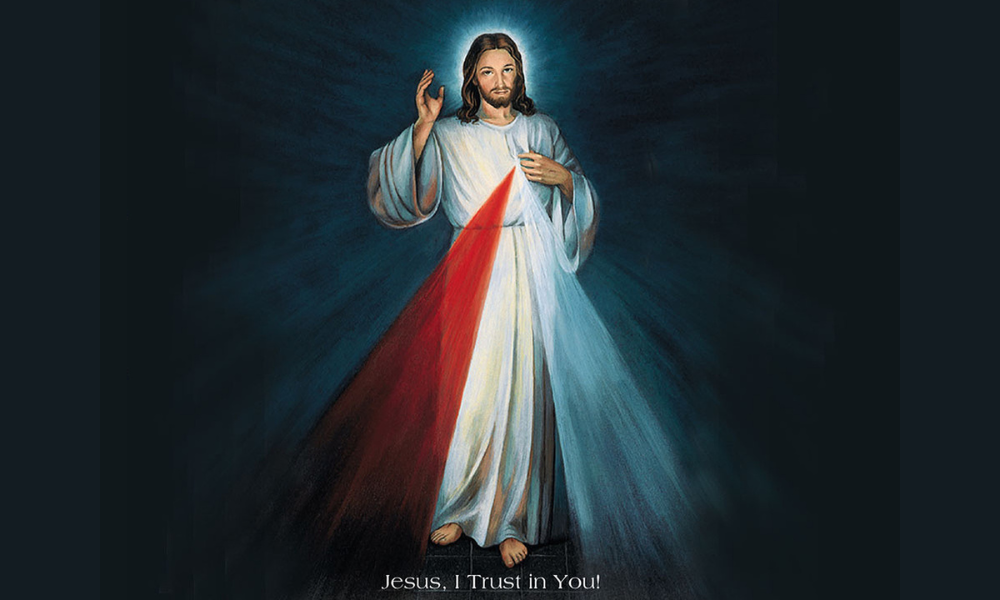
The Lord asked that an image be painted with the words “Jesus, I trust in You,” and that devotion to His mercy be spread throughout the world.
Pope St. John Paul II and Divine Mercy
The message of Divine Mercy spread throughout the Church in a profound way through Pope John Paul II, who had a deep personal devotion to it.
In the year 2000, he canonized St. Faustina and officially established Divine Mercy Sunday as a feast for the entire Church. He called her “the great apostle of Divine Mercy in our time” and emphasized that mercy is at the very heart of the Gospel.
Providentially, Pope John Paul II died on the vigil of Divine Mercy Sunday in 2005, further linking his legacy to this powerful devotion.
Divine Mercy Chaplet
At the center of this devotion is the Chaplet of Divine Mercy, a simple yet powerful prayer given to St. Faustina by Jesus in 1935.
Prayed using a rosary, the chaplet invites the faithful to offer the Passion of Christ to the Father in atonement for sins, pleading for mercy “on us and on the whole world.”
Jesus promised extraordinary graces through this prayer, especially at the hour of death, assuring that His mercy would surround those who trust in Him. The chaplet is often prayed at 3:00 p.m. – the Hour of Mercy – the time of Christ’s death on the Cross.
The devotion calls the faithful to three essential actions:
- Trust in Jesus
- Receive His mercy
- Extend mercy to others through word and deed
Divine Mercy Sunday offers a profound invitation: to encounter the risen Christ with trust. On this day, the Church encourages the faithful to receive the Sacrament of Reconciliation (may also be received prior to this day) and the Eucharist, opening their hearts to the grace Christ longs to give. No sin is greater than God’s love. His mercy is available to all who seek it.
As we celebrate this Sunday, we echo the simple yet powerful prayer entrusted to St. Faustina:
Jesus, I trust in You.
For more information about Divine Mercy, click here.
To find a parish near you for Mass and Reconciliation, click here.