Clinging to Jesus in the Eucharist
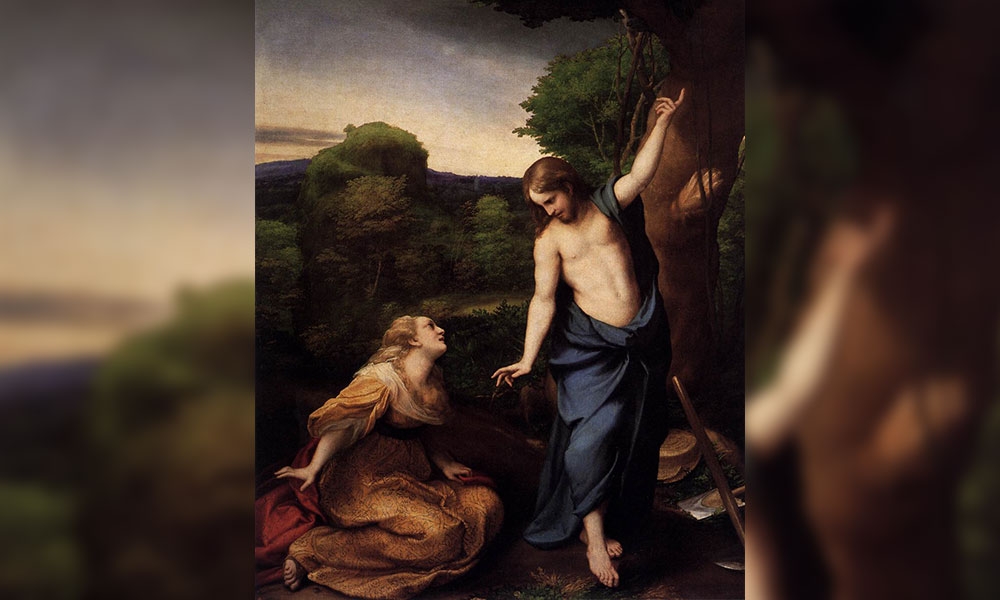
Getting your Trinity Audio player ready...In life and death Mary Magdalene desired to be physically close to her Lord. We see this in the account of Jesus’ appearance to Mary Magdalene on Easter Sunday. Mary remains by the empty tomb weeping, seeking the Lord’s body which she believes has been stolen. When Christ appears to his grieving friend, Mary reaches out to touch her Lord as she so often had done before, perhaps, this time to ensure she will not lose him again. Yet Christ reprimands Mary, forbidding her to touch him as he has not yet ascended to his Father.
In life and death Mary Magdalene desired to be physically close to her Lord. We see this in the account of Jesus’ appearance to Mary Magdalene on Easter Sunday. Mary remains by the empty tomb weeping, seeking the Lord’s body which she believes has been stolen. When Christ appears to his grieving friend, Mary reaches out to touch her Lord as she so often had done before, perhaps, this time to ensure she will not lose him again. Yet Christ reprimands Mary, forbidding her to touch him as he has not yet ascended to his Father.
This response can seem baffling. Why does Christ dismiss Mary Magdalene? Isn’t the desire to cling to God good? Doesn’t God want us to desire Him and cling to Him? After all, St. Teresa of Calcutta often repeated: Jesus thirsts for us. He desires us exclusively.
Our desire to embrace and remain with God is indeed good. The fact that we yearn for this is in itself a grace from God. Therefore, Jesus is not dismissing Mary’s desire; rather, he instructs Mary how she must hold fast to Him after His ascension.
The Ascension will leave Mary unable to cling to Christ’s body in the manner she has been accustomed to before the Resurrection. Christ understands this and wishes to fulfill Mary’s desire for Himself in a deeper and more permanent way. He prepares Mary to cling to him in a more intimate way through his Church. There Christ will sanctify Mary, giving her his very life — grace — through the sacraments, most especially through the gift of his Body, Blood, Soul and Divinity in the Eucharist.
Through this sacrament, Mary can cleave to her risen Lord forever, adoring and receiving Him and recalling His presence within her. There He will unite Himself to her, conform herself to Him, remain with her and continually increase His presence within her soul. In return, Mary can continually unite herself to Christ, giving Him her very self, and share her joys and sufferings with her Eucharistic Lord.
As with Mary Magdalene, we, too, at times find ourselves wishing to reach out to touch Christ throughout our day. We may wish merely to touch the hem of His garments when asking for healing for ourselves or a loved one; grace when tempted or struggling with sin; in moments of uncertainty; or when we sorely need patience. Other times we may simply wish to see Christ present when relaying our joys and sorrows, believing that this will bring comfort and peace.
Yet, as St. John Chrysostom preached, we, too, touch Jesus. We see Jesus. We consume Him. We are made one with him. He dwells in our souls. There is no closer union than this. Every time we present our needs and lives to Christ, remain in His presence in front of the Blessed Sacrament and receive Him in the Eucharist, we touch Christ. With each holy Communion, we become more intimately united to the living God as there he cleanses us of our venial sins and increases his presence in our souls. But do we realize this? Do we seek Jesus in the Eucharist and unite ourselves to Him?
It takes faith to encounter the Eucharistic Lord in this way. But when we do, we find Jesus heals us, comforts us, strengthens us, accompanies us and ultimately fulfills our deepest desire: the desire for Himself. Through the Eucharist, we can forever cling to Jesus, and He to us. There we are made one with Him.
How to Make a Holy Hour
A Holy Hour is one quiet hour with Jesus. Keep it simple. Show up, breathe, and be with Him.
1. Arrive (about 5 minutes)
- Make the Sign of the Cross and say a prayer slowly: “Jesus, I’m here.”
- Offer Him your intention (a person, need, or thank you).
- Take a couple of slow breaths. Let your shoulders drop. Place distractions in God’s hands.
2. Adore (10–15 minutes)
- Gaze on the Lord in the tabernacle or monstrance. Be still.
- Say short, simple prayers: “My Lord and my God.” “Jesus, I trust in you.”
- If your mind wanders, don’t worry. Gently come back to Jesus–no scolding, just begin again.
3. Scripture or Rosary (20–30 minutes)
- Scripture: Read a short passage (John 15:1–11; Luke 24:13–35; Psalm 23). Notice one word or line. Talk to Jesus about it. Listen.
- Rosary: Pray one or two decades. Name an intention at the start; linger on a mystery of Christ’s life.
4. Thanksgiving and Mission (5–10 minutes)
- Thank Jesus for this time, even if it felt quiet or dry.
- Make one concrete resolution for today (a call, an apology, an act of kindness).
- Close with an Our Father, Hail Mary, and a Glory Be. Silence tips
- Keep it simple. You don’t have to “do it right.” Just be with Him.
- Use a short phrase to refocus: “Stay with me, Lord.”
- Dry prayer is still good prayer. Staying is love.
- End distractions kindly. Notice them, give them to Jesus, and return to Him.
Maria Cintorino holds a degree in theology. Her writings have appeared in several publications including Homiletic and Pastoral Review, Our Sunday Visitor, and the National Catholic Register.